
Find the problem behind the brief. Never accept a brief without interrogating it. Ask three additional questions before writing a single requirement. The real problem is almost always one layer deeper.
copy
01
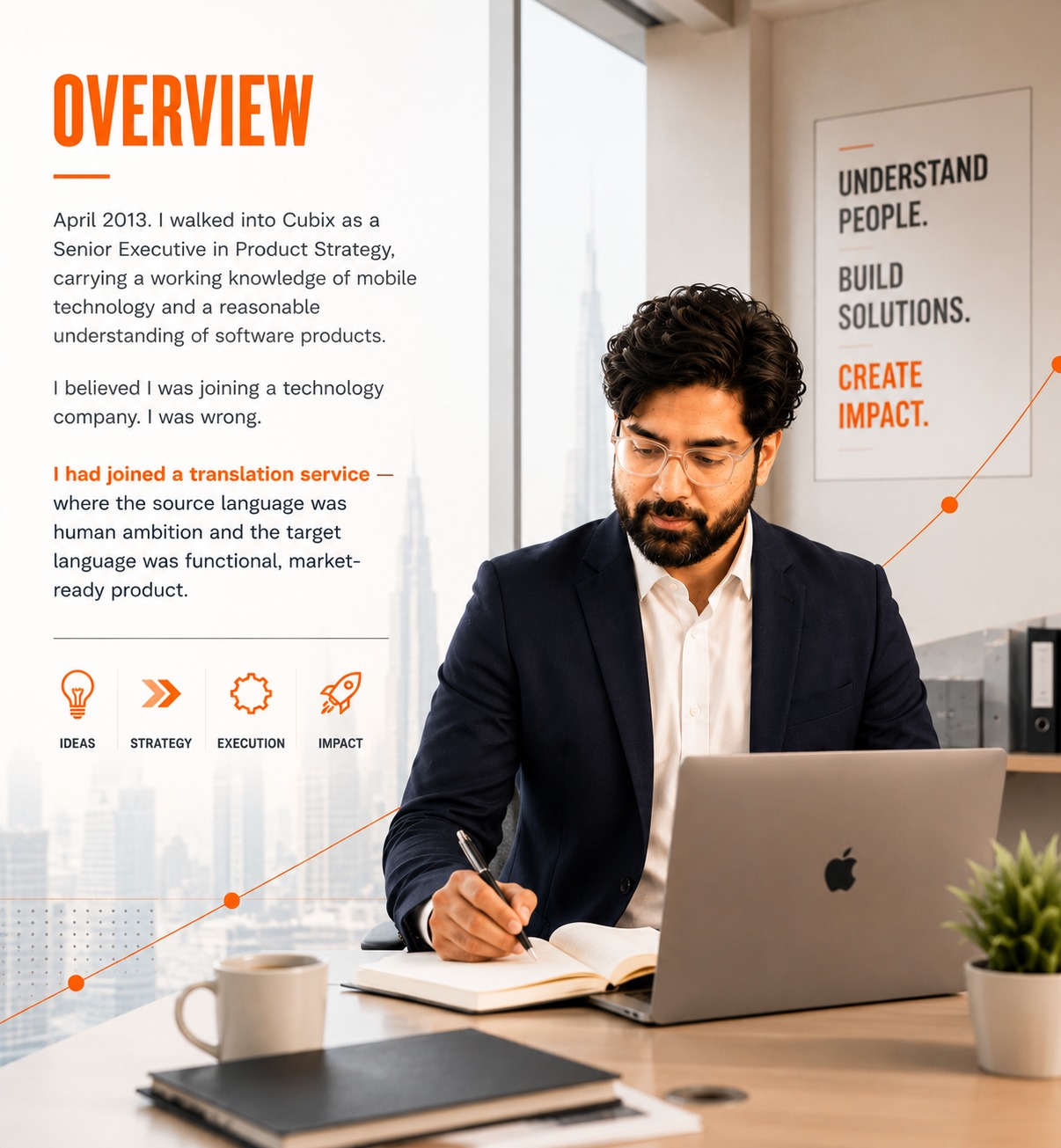
Overview
April 2013. I walked into Cubix as a Senior Executive in Product Strategy, carrying
a working knowledge of mobile technology and a reasonable understanding of
software products. I believed I was joining a technology company. I was wrong.
I had joined a translation service — where the source language was human
ambition and the target language was functional, market-ready product.
Cubix built mobile solutions for SMEs across the Middle East — a market digitizing
rapidly in those years. Business owners in Dubai, Riyadh, and Kuwait were waking up to
competitors moving online. They came to us with money, urgency, and ideas. My role was
to take those ideas and build something real from them.
What nobody warns you about is how little of it has to do with technology. The hardest
part was never the product. The hardest part was the person. Specifically — learning to
hear what a client was actually saying underneath what they were telling you. Those are
two very different things. Confusing them is the most common and most expensive mistake
in any client-facing role.
The Challenge
The challenge was not technical. Cubix had strong engineering capability. The challenge was strategic — and it repeated itself across every engagement.
01
Clients arrived with solutions, not problems
Every client came in with a feature list and a timeline. The solution felt decided before the first meeting. The actual business problem — the one the solution was meant to address — was buried several layers deeper and rarely examined before work began.
02
Market context was systematically underestimated
Mobile product patterns from Western markets did not transfer cleanly to the Gulf. Consumer trust, payment behavior, and brand interaction operated on different cultural logic — logic that had to be researched, not assumed.
03
Revenue potential was being left on the table
Clients were solving narrow problems when broader product strategies could have created entirely new revenue lines. The brief as presented was almost always smaller than the opportunity the brief was sitting on top of.
04
Over-scoping was increasing cost without increasing value
The path of least resistance — agreeing to everything and building it all — produced bloated, unfocused products that cost more to build and delivered less commercial impact. Cost discipline and outcome focus had to be built into the strategy from day one.
04
The Story — A Project That Changed Everything
A mid-sized retail chain from the UAE came to us wanting a mobile shopping app. Standard
brief. E-commerce functionality, push notifications, a loyalty points system. Clean
scope, reasonable budget. We could have taken it, built it, delivered it on time, and
everyone would have left professionally satisfied.
I almost did exactly that. Then something made me pause. Before I opened a single
wireframe, I asked two questions that were not on the brief. How are your best customers
currently buying? And — what did you try before this that did not work?
The answers were not what I expected. Their best customers — working professionals in
Dubai buying items needed for the following workday — were not shopping online because
they did not trust delivery. One missed delivery on a time-sensitive item had
conditioned them to walk into the store rather than risk it.
The problem was not the shopping experience. The problem was trust in the last mile. No
amount of push notification optimization or loyalty architecture was going to fix
that.
We rebuilt the brief from scratch. Smaller scope. Narrower feature set. But at the
center of the product was a real-time delivery tracking feature with a visible
reliability commitment. The conversion rate from app users outperformed their desktop
channel within the first quarter. Not because we were smarter — because we asked the
question most agencies skip.

03
The Strategy
The approach I developed was not borrowed from a book. It was built through repeated contact with what worked and what did not. Three principles became the foundation of everything

Build new product lines that create revenue, not just features that satisfy. Every project was evaluated not just on delivery quality but on its potential to generate new commercial value for the client. Features that did not serve a revenue or retention outcome were challenged.
Minimize scope to maximize impact — and reduce cost without reducing value. Narrower, more precisely targeted products consistently delivered better commercial outcomes at lower build cost. The discipline of cutting what was not essential became a competitive edge.
05
Results & Impact
The approach of identifying new product opportunities, building for revenue impact, and controlling scope to minimize cost compounded across every engagement at Cubix.

New ventures created
Multiple clients left Cubix engagements with product capabilities — and revenue lines — that did not exist when they arrived. The brief was rarely the ceiling of what was built.
Revenue impact
Products designed around the real commercial problem consistently outperformed those built to specification. Revenue from new digital channels opened by these products was directly traceable to the strategy, not just the execution.
Cost discipline
Narrower scopes, built with precision, consistently came in at lower cost than over-specified alternatives — while delivering stronger commercial outcomes. The clients who trusted the narrowing approach got more for less.
Career progression
Sr. Executive to Asst. Manager in 6 years — reflecting the commercial impact of the approach, not just delivery competence.
06
What Went Wrong — The Real Mistakes

The lessons that changed how I work came from the projects that disappointed — the ones where I did not push hard enough, early enough.
Accepting briefs without interrogating them
Every time I took a brief at face value, I built the wrong thing well. The opportunity the client was sitting on went undiscovered. The revenue that could have been created was left on the table.
Missing the new venture opportunity inside maintenance requests
Some of my best product-building opportunities came disguised as minor enhancement requests. When I treated them as tasks rather than signals, the growth opportunity passed. When I paused and asked what this request was really indicating about the client's market position, it opened into something much larger.
Over-scoping to avoid difficult conversations
Saying yes to everything felt like good service. In reality it increased cost, diluted focus, and reduced the commercial impact of everything built. The discipline of cutting what was not essential had to be fought for on every engagement.
Underestimating Middle Eastern market specificity
Assuming universality where there was specificity meant building products that did not convert as expected — wasting both budget and the market opportunity the product was supposed to capture.
07
Key Learnings
These lessons did not stay inside product strategy. They transferred into every role that followed — B2B sales, business development, digital marketing leadership
Every brief sits on top of a growth opportunity — find it
The stated requirement is almost never the full picture. The strategist who asks what growth is possible here, not just what is being asked for, consistently delivers more commercial value.
New product lines are built from listening, not invention
The best new ventures I helped create at Cubix came from paying close attention to what clients struggled to articulate. The opportunity was always in the gap between their frustration and their current solution.
Revenue and cost are strategic variables, not accounting outcomes
Every product decision has a revenue implication and a cost implication. Treating them as strategic levers — not just financial results — is what separates high-impact product strategy from competent delivery.
Scope discipline is the most valuable form of cost control
The most effective way to reduce cost without reducing value is to cut with precision rather than reducing quality. Know exactly what the product needs to do commercially — and build only that.
Skills compound across disciplines — build them with intent
Seven years of product strategy built a way of thinking that followed into B2B sales, leadership, and digital marketing. Every lesson from this phase showed up again in a different form in every role that followed.
Markets are not universal — the opportunity is in the specificity
The clients who gained the most were the ones whose market context was understood in detail. Generic solutions produce generic results. Market-specific products create defensible competitive advantages.
08
Conclusion
Seven years at Cubix established the professional signature that has defined every role since. Walk into an organisation. Identify the growth that is already waiting to be built. Create the product or venture that captures it. Drive revenue from channels or capabilities that did not previously exist. Control cost by building with precision rather than volume.
That pattern — new venture creation, revenue growth, cost discipline — did not originate at Cubix. But it was here that I first understood it as a deliberate approach rather than a lucky outcome.
When I moved into B2B sales at VIDIZMO, those instincts transferred immediately. When I moved into leadership at Soft Fellow, they scaled. When I moved into digital marketing at Softcino, they became the foundation of how I approach every campaign, every channel, and every investment decision.
The work that looks like product strategy on the surface was, underneath, always the same thing: finding the growth that was already there — and building exactly what was needed to reach it.

The best thing that can happen early in your career is to be held accountable for outcomes, not outputs. That accountability teaches you to find the growth in every room you walk into — and to build toward it with discipline, not noise.

Let's build marketing that actually moves people.
From early-stage startups to scaling U.S. enterprises — I've driven growth at every level.

Let's talk
contact@hassanosaid.com

View My Final Paper
›